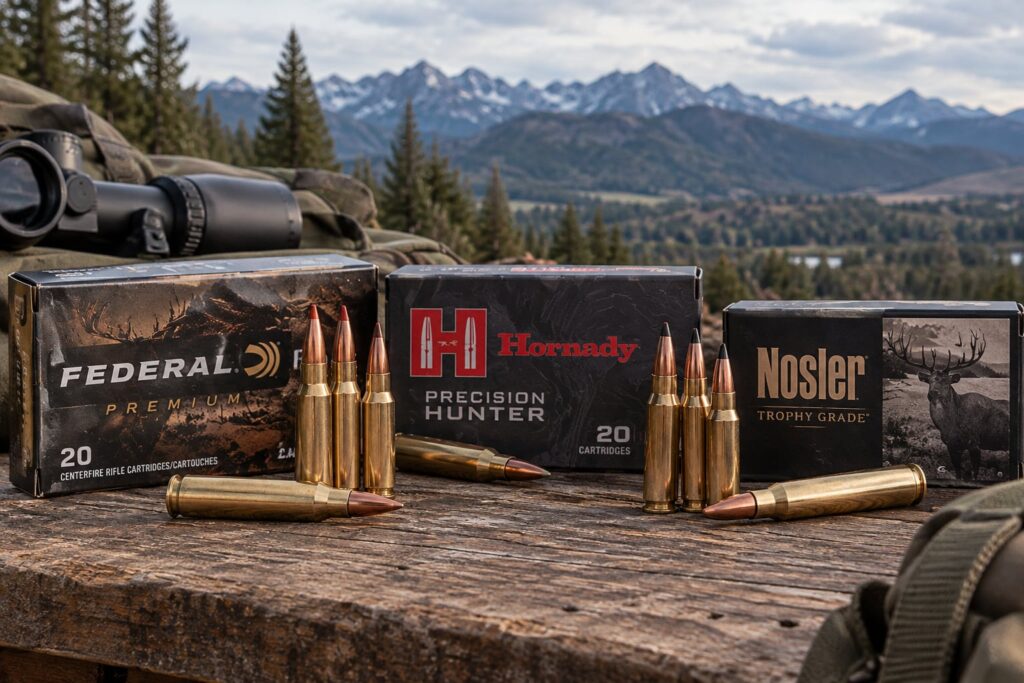
Choosing a hunting rifle cartridge involves balancing several factors: recoil, trajectory, ammunition availability, and the type of game being pursued.
Popular cartridges such as the .308 Winchester, 6.5 Creedmoor, .30-06 Springfield, and .300 Winchester Magnum have earned their reputations for different reasons. Understanding their characteristics can help hunters compare rifle platforms and ammunition options more effectively.
Popular Hunting Rifle Cartridges Compared
| Cartridge | Recoil* | Common Hunting Applications | Key Characteristic |
|---|---|---|---|
| .308 Winchester | Moderate | Deer, elk | Versatility and availability |
| 6.5 Creedmoor | Mild–moderate | Deer, antelope | Aerodynamic bullet designs |
| .270 Winchester | Moderate | Deer, antelope, elk | Relatively flat trajectory |
| .30-06 Springfield | Moderate–high | Deer, elk, moose | Broad ammunition selection |
| 7mm Remington Magnum | High | Deer, elk, Western big game | Magnum performance |
| .300 Winchester Magnum | High | Elk, moose, larger game | High-performance .30-caliber design |
Recoil is relative and depends on rifle weight, ammunition, and configuration. Hunting applications describe common historical uses, not guarantees of suitability.
Understanding the Differences
.308 Winchester — Versatility and Availability
The .308 Winchester is one of the most established centerfire rifle cartridges. Its short-action design allows manufacturers to build relatively compact bolt-action rifles, and it is also widely available in semi-automatic platforms.
It offers a broad selection of factory ammunition and generally produces less recoil than larger .30-caliber magnum cartridges.
Best known for: Versatility, widespread ammunition availability, and compatibility with numerous rifle platforms.
6.5 Creedmoor — Modern Ballistic Efficiency
Originally developed for precision shooting, the 6.5 Creedmoor has become popular in modern hunting rifles.
Its reputation is closely tied to streamlined, high-ballistic-coefficient bullets that retain velocity efficiently. It also typically produces manageable recoil compared with many larger hunting cartridges.
Best known for: Aerodynamic bullet performance, moderate recoil, and popularity in modern precision-oriented rifles.
.270 Winchester — A Traditional Hunting Favorite
Introduced in 1925, the .270 Winchester has a longstanding reputation among North American hunters.
Its combination of velocity and trajectory characteristics helped establish it as a popular sporting cartridge, particularly in traditional bolt-action hunting rifles.
Best known for: Relatively flat trajectory, established hunting history, and broad factory-ammunition support.
.30-06 Springfield — A Proven Classic
With more than a century of history, the .30-06 Springfield remains a staple of American hunting.
Its larger case capacity compared with the .308 Winchester supports a broad range of factory ammunition offerings. It is commonly chambered in standard- and long-action hunting rifles.
Best known for: Versatility across a broad range of sporting applications and extensive ammunition selection.
7mm Remington Magnum — Established Magnum Performance
The 7mm Remington Magnum combines a larger case capacity with a wide selection of aerodynamic 7mm projectiles.
It has a longstanding association with Western big-game hunting and is available in numerous premium bolt-action rifles.
Its performance characteristics generally come with increased recoil and muzzle blast compared with standard non-magnum cartridges.
Best known for: Magnum-class ballistics and established use in Western hunting.
.300 Winchester Magnum — High-Performance .30 Caliber
The .300 Winchester Magnum is one of the most recognized .30-caliber magnum cartridges.
Although it uses the same nominal bullet diameter as the .308 Winchester and .30-06 Springfield, its case design and capacity differ substantially.
It is commonly represented in premium hunting and long-range precision-rifle catalogs.
Best known for: High-performance .30-caliber ballistics, broad manufacturer support, and substantial recoil.
Which Cartridge Characteristics Matter for Different Game?
Rather than treating a cartridge designation as a guarantee of suitability, it’s useful to understand how cartridge characteristics relate to different hunting environments.
| Hunting Context | Commonly Discussed Cartridges | Important Considerations |
|---|---|---|
| Deer and antelope | 6.5 Creedmoor, .270 Win., .308 Win. | Recoil, rifle handling, ammunition construction |
| Elk and larger game | .30-06, 7mm Rem. Mag., .300 Win. Mag. | Ammunition specifications, local regulations, hunting conditions |
| Mountain and backcountry hunting | 6.5 Creedmoor, .270 Win., .308 Win. | Total rifle weight, portability, recoil |
| Western hunting | .270 Win., 7mm Rem. Mag., .300 Win. Mag. | Terrain, rifle configuration, environmental conditions |
These examples reflect common hunting associations. Appropriate cartridge and ammunition selection depends on the specific animal, applicable regulations, and other field conditions.
Standard vs. Magnum Cartridges
One important distinction is between standard hunting cartridges and magnum designs.
Standard cartridges such as the .308 Winchester, 6.5 Creedmoor, and .30-06 Springfield are widely available in conventional hunting-rifle platforms and generally offer manageable recoil characteristics.
Magnum cartridges such as the 7mm Remington Magnum and .300 Winchester Magnum typically feature greater case capacity and can deliver higher velocities with comparable projectile weights.
However, those characteristics also introduce tradeoffs involving recoil, muzzle blast, rifle weight, and ammunition cost.
A magnum cartridge is not automatically superior for every hunting application.
Bullet Construction Matters Too
Cartridge designation is only part of the ammunition specification.
Factory hunting ammunition may use conventional soft-point, bonded, monolithic copper, or polymer-tipped bullets. These designs differ in construction and intended performance characteristics.
Two loads using the same cartridge can therefore have substantially different specifications.
It’s also important to distinguish between caliber and cartridge. The .308 Winchester, .30-06 Springfield, and .300 Winchester Magnum all commonly use .308-inch-diameter bullets, but they are separate cartridges and are not interchangeable.
Always use ammunition that matches the firearm’s designated chambering.
Final Thoughts
There is no single hunting rifle cartridge that is ideal for every application.
The .308 Winchester and .30-06 Springfield remain established all-around sporting cartridges. The 6.5 Creedmoor reflects modern precision-oriented design, while the .270 Winchester continues a longstanding hunting tradition.
The 7mm Remington Magnum and .300 Winchester Magnum offer different magnum-class characteristics, accompanied by additional tradeoffs.
Understanding these differences makes it easier to compare hunting rifles based on their intended use, mechanical design, and available ammunition rather than relying on cartridge popularity alone.